Showing posts with label 5s. Show all posts

Sunday, November 17, 2013

How to calculate time savings after reducing distance traveled

One of the goals of a lean kaizen event is to reduce the overall lead time, from when an order is officially placed by your customers, until you deliver the order to the customer. The longer the lead time, the more money your company needs to have in cash flow and inventory to account for this delay.

Typically, the lead time is significantly longer than the actual time to produce the product or service, often times 10-20X longer than the cycle time (only 5-10% of the lead time is spent working on the order, the rest of the time it sits or gets moved around the facility). For example, if your process is 5 steps, and each step takes one hour to complete, it is not surprising that it can take 50 hours or longer to process an order through the system (5 hours of cycle time x 10 = 50 hours).

One of the first improvements you can make to your process is to reduce the time spent BETWEEN the process steps, in order to reduce the amount of delays and excess transportation in the process.


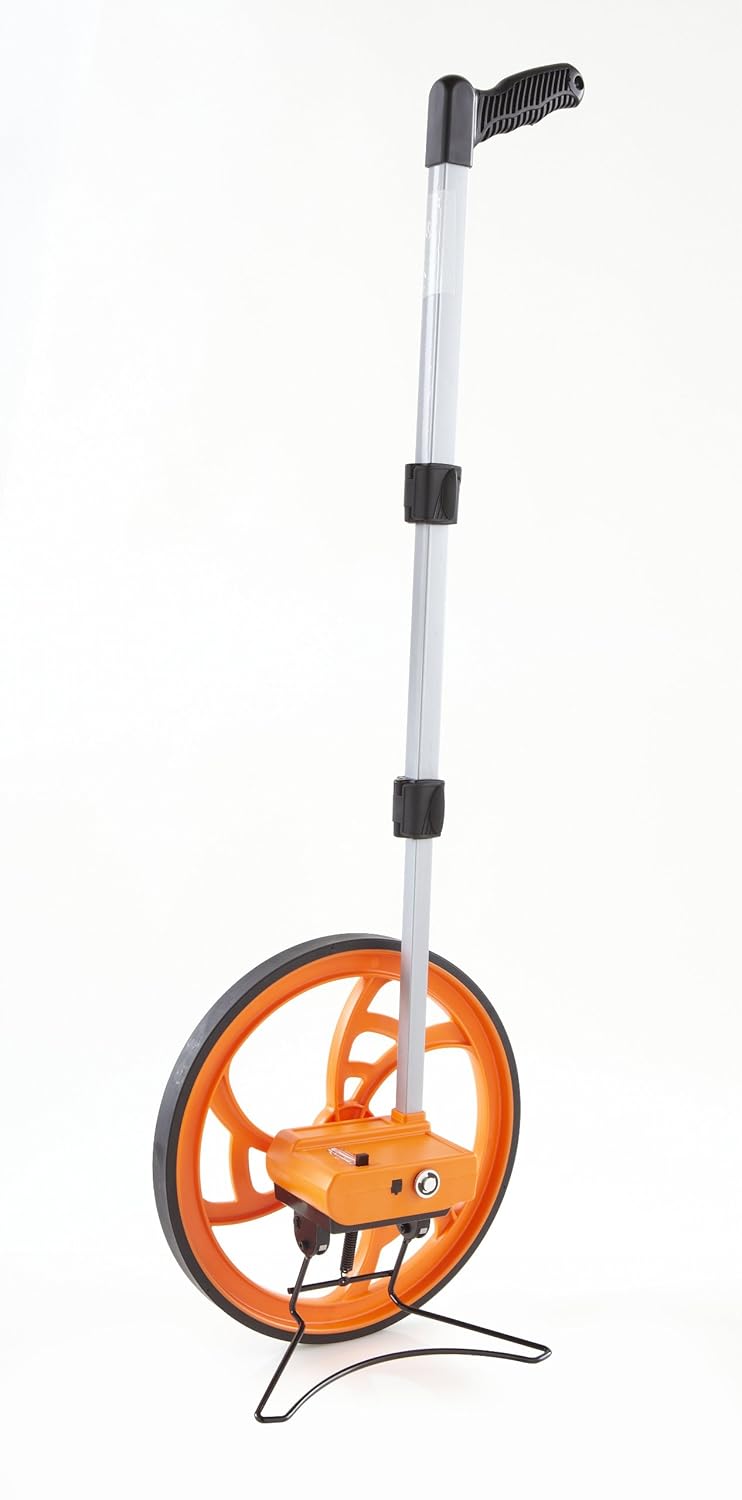
This can be measured by using a distance measuring wheel to follow the flow of products or people through the process, or measured by AutoCAD or tape measure. The total distance traveled can be calculated before and after the improvements to determine time savings.

According to the book Making Materials Flow, each step of walking is equivalent to 2.5 feet. Each step (2.5 ft) is equivalent to 0.6 secs. If you use the metric system, one step equates to 0.762 meters. Said another way, for every 4.166 feet traveled (1.27 meters), one second of time is wasted.

Therefore, if your process distance traveled is 10,000 feet per day, let's look at the calculations:

10,000 ft / 4.1667 ft/sec = 2400 seconds = 40 minutes = 0.67 hours

3048 m / 1.27 m/sec = 2400 seconds = 40 minutes = 0.67 hours

Next, you can multiply your labor rate x the number of hours of travel. For example, if the labor rate is $30 per hour (including all benefits), then $30 x 0.67 hours = $20 of wasted time per day. If you work 20 days per month, then the cost is $400 per month wasted due to travel.

Any other calculations you've used to capture walking distance savings?

Monday, June 13, 2011

Six business improvement ideas you can implement today!

Sometimes us consultants get a bad reputation for making things more complicated than they need to be. We turn people away when we don't put process improvement tools in layman's terms that anyone can understand.

I was reminded of this when working with a small family restaurant recently. If I mentioned standard work, theory of constraints, 5-S, kanban, or PDCA, I would have been escorted out the door. They aren't used to hearing these terms, like some of our larger manufacturing clients are.

I needed to explain it to them, without the consultant "lingo". In fact, we applied every single one of the tools mentioned above, but we didn't call them by their name.

As I mentioned in my last blog, there are simple tools that any business can start with, that almost always gain some improvements.

We decided to package them into a one-page sheet. We identified six different suggestions for businesses who aren't sure where to get started. You can download a copy of them at the bottom of the page.

1) Workplace organization, cleaning and labeling – With your staff, get rid of everything you don’t need very often (put it in storage or recycle it). Everything that remains should be stuff used quite often. Label it and make sure there is room for it somewhere. Clean up the area, to make it shine, so that it looks like a brand new area (this gets the workers excited). Setup a process to put things away after use, and maintain the cleanliness and organization, so it doesn’t go back to the mess it was before.

2) Customer Surveys - send out a survey to your customers, and ask them how you can improve your products and services. Be open to input they receive, and gather the top 3 ideas for implementation.

3) Employee Brainstorming - Gather your employees and “brainstorm” ways to improve the business. Your employees hear the complaints and deal with the inefficient processes, so listen to what they say. Make sure you ask them about risks of problems, not just those that have actually happened (employee turnover, close-call accidents, anticipated issues, mistakes that almost made it to the customer, etc).

4) Reduce backups - Look for areas in your business processes where the work piles up or gets backed up(called “bottlenecks”). If you can improve the efficiency in that area, the results are often seen immediately with your customers.

5) Document tasks - develop a standard and consistent approach for doing key activities and tasks in your business. Write them down, so everyone knows how it should be done. If someone comes up with a better idea, update the steps. Provide as many photos and pictures as possible.

6) Cross-train employees - train other employees to be able to do multiple tasks and skills (not the same as multi-tasking, which tends to be inefficient overall). This gives you a more flexible workforce, so in case you get overloaded in one area, or someone is out sick or on vacation, you aren’t keeping the customer waiting, or providing poor service, or not responding to them at all.

Even really mature and highly efficient companies go back to these basic improvement approaches over and over again. They are critical for success.


Download a copy for free! Six Ideas to Improve Your Business Today!

Saturday, March 5, 2011

Start simple before you map your processes

We see a lot of different processes at various levels of process performance. Some are running near six sigma levels, while others don't even think they have a process that they follow.

The maturity of the process should determine the type of tool to apply.

If your process is just getting started with process improvement, has no metrics, have never defined a common process, and doesn't know where to begin, start simple. The two tools we recommend are 5-S and standard work (actually let's call it consistent processing, since standard work is more complex than it seems).

5-S is a way to clean and organize the workspace, so that unneeded items are removed, needed things are well-labeled, easy to find, everything has it's place, so it's easy to see when there are problems in the workspace. To maintain these methods are difficult, but the first couple phases are easy and can gain some quick efficiency gains, along with a pleasing appearance.


Consistent processing is about defining a process that can be followed by everyone involved in the process, so that the problems created by differences in approaches can be reduced, and the new process can be adjusted according to problems that occur going forward. It's too confusing to try and improve a process that doesn't have any repeat performance. When you look for root cause, there are often so many process issues that can "muddy up the waters".

I recently helped with some yield problems at a facility. We had the failed unit hooked up to the test equipment, asking all kinds of questions, testing different scenarios, trying to identify what could be the problem. When we finally decided to open up the unit, it was missing a major part! You end up wasting a lot of your time investigating the simple stuff, and it slows down the improvement process (instead of working on the major issues). Establishing some standards for assembling, repairing, reworking, and verifying processes is a must!

You might also be concerned that workers will feel "confined" by a standard.

Here is what you can do to alleviate their concerns:

1) Involve them in developing the process, so they own the process, and feel a part of its development.

2) Reiterate that the standard is the safest and most efficient way to do a process TODAY, but can be improved or changed at any time.

3) Recognize those individuals who helped establish the best process, and those who improve it, to encourage others to come up with better ways of doing something. If they get some motivation from being recognized by their co-workers and leaders, then they may spend time trying to think of better ways to improve the standard.

If you can instill that kind of thinking in your people, you are really maturing as a company.