Friday, August 17, 2012

Reducing your time might seem like lean, but you can easily anger your customers

Lean is about increasing value to your customer. Often times, this requires you to eliminate waste in the process. However, if you don't understand your customer needs, you might sub-optimize the process in an attempt to make your work easier. However, if you are not careful, you can actually ADD waste to your customers, thus decreasing the value you provide. That is the complete opposite impact you intended, even though you had the right intentions.

Here are some good examples of sub-optimization that you can share in training classes or conversations. I'm sure you have some good examples of your own. Please share them in the comments section below. 

Example #1 - Scrap Report
The Finance department provides a weekly and monthly scrap report to the production managers. The data is in a single spreadsheet file, with filters on the top of key columns (work center and manager). Each manager goes in and searches the report to filter by their name, look at the scrap items, and review them. Some of them create their own pivot table to be able to sort and filter all the data. Each month is separated into unique tabs (pretty common in finance reports), which makes it difficult to look at data over the whole year. The finance person did not want to spend an extra 10 minutes each time creating the pivot table report and combining the new data with the existing data for the entire year in one spreadsheet. However, when we look at the full impact of time for the entire company, each production manager is required to create their own pivot table (5 minutes each), or they spend extra time filtering the data (not as efficient as a pivot table), or they completely ignore the report, since they find it hard to analyze. So the finance person saves themselves ten minutes each week, but this time adds at least an hour to the entire organization, and not everyone is taking action on the data, which is an even bigger waste.


Example #2 - Procedure Updates
Each month, an email is generated from the document control group with a list of procedures that were revised recently. At least 1000 people are sent this list. They were asked to provide a quick summary of the change made in each document, so we could decide if it was something we needed to investigate or read in more detail, or if we could ignore it. He said it would add about an hour's worth of his time to do that, so he refused. However, if we assume that 10% of the distribution is actually interested in these changes, that means at least 100 people are clicking each of the procedures and scanning through to find the revision change summary. If we assume that takes 5 minutes to complete, then 500 minutes (8 hours) have been wasted in the company. So the document control group saved themselves one hour of work, but added 8 hours of work to the company, and many people did not get the updates they needed, which is a huge waste. If they did provide a summary, they might actually increase the number of people on the distribution who learn about the revisions, and therefore proceed to click the links to read the updates.

Example #3 - IT help desk ticket
I needed to have a website updated, so I contacted the information technology (IT) person responsible for the task. I have this task performed a couple times per year, so it is infrequent. The individual said they could take care of it, but I need to submit a ticket for them to work on it. I agreed, and called the help desk line to submit the ticket. After 30 minutes of discussion with the help desk support person, I finally got the ticket submitted. I was very frustrated. The company wasted 30 minutes of my time, and 30 minutes of the help desk's time to get the ticket entered correctly. This was due to the complex nature of the work being done. The person who was going to be doing the work could have probably entered the ticket themselves in about 5 minutes, since they knew exactly what was needed to be done. So they saved themselves five minutes of work, but added one hour of waste to two other individuals.

As you can see, the key message is to understand what things you do that are valuable (value added) to your customer, and what things are not valuable (non-value added). Only eliminate the non-value added, or you could make your customer's upset and frustrated.

Thursday, July 26, 2012

Problem solving is critical for any business

Does your company have a problem solving process, like PDCA or 8-D?

If so, do people use it? How do you know?

Simple, ask for documentation. If an employee or improvement team is really working on a problem, and they aren't writing down or documenting what you're doing, then how well are they following the process? If the process is "in their head" then it's either a really simple problem, or they're probably missing some steps.

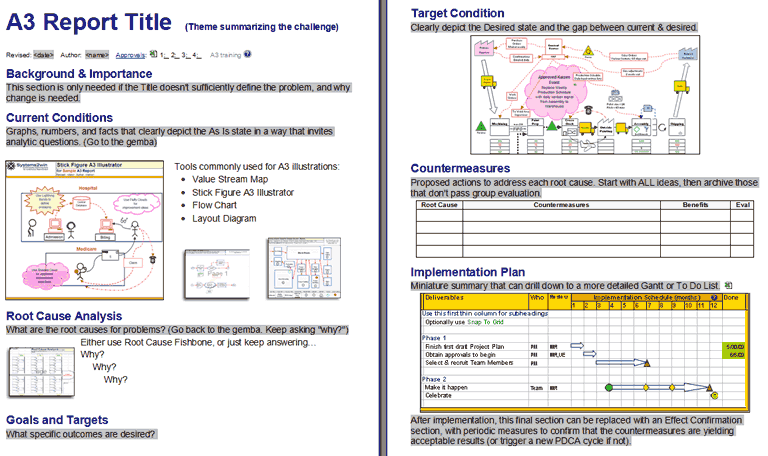
Example A3 Report
Here are some simple questions you can ask people in your company, to see if they are following the process and structure, if they can't provide documentation to prove it. 

What is the problem you are trying to solve?


Many teams cannot clearly articulate the problem, so they will struggle solving the problem if it is not well defined. This step can take a long time to complete, depending on the complexity of the problem. Teams often skip through this step quickly, so they can get to root cause right away and have some answers from management. Encourage them to take their time and make sure the problem statement is clear before moving on.

What step of the problem solving process are you in?


This will help you understand whether your employees are following the process or not, and help you understand how far along they are with this problem/issue. If they struggle answering the question, they may not be very knowledgeable about the process, or jumping around steps and working out of order. 

What data did you use to determine the root cause?


This will help you understand how well the root cause was investigated. If little to no data was used, then the solution will have much less chance of being successful, so the odds that they are actually addressing the right cause is slim to none. I find that teams that give up on collecting data and skip ahead to solutions are also less likely to adhere to the problem solving process.

Is your solution addressing the long term?


Many solutions address the immediate need, or contain the problem in the short term only, but they do not complete the entire 8-step process to prevent the problem from recurring. This happens often because after containment is in place, management stops asking about the issue, so the teams get pulled into the next "fire" instead of completing the problem solving process on the issue. This will be evident when you ask about different problems they've worked on, but they can't explain what actions were taken to prevent the problem from coming back. If the problem hasn't recurred, but no improvements were made, then don't be surprised when it does come back as next month's "fire".

There are many other questions you can ask, but these will give you a pretty good indication.

Finally, don't just ask the quality organization about problem solving around product failures. These departments may have contractual reasons to follow the process, as it probably gets submitted to the customer. Instead, talk to your HR department, your shipping department, Invoicing department, and even your Lean/Six Sigma organization (yes, we don't even follow our own recommendations all the time for our own issues). Problem solving is a company-wide process that everyone should be using on their top problems.

Tuesday, July 24, 2012

We don't need any help, we are already lean!

"Lean and Six Sigma are only for manufacturing organizations!"
"Our processes/company is unique, so that won't work here!"
"We're already lean because we're working so hard and so many hours!'

What "lean" looks like to people who don't get it yet.

Have you heard these comments before? That's the first sign of a company in desperate need of process improvement. 

I'll admit, there is some difficulty in getting people in a transactional or office environment to embrace lean and six sigma concepts. The biggest issue is that they can't SEE their workflow, so they cannot easily translate a manufacturing example (often used in training materials) to their own jobs.

I'll also admit, I can lean out anyone else's process, but when I decided I needed to lean out my own work, I ran into some difficulties.

After some serious evaluation of what I actually do (when not training or consulting, those are easy), I realized that I provide "items" to my customers. Items could be book summaries, templates, training material, procedures, guidelines, reference material, examples, recommendations, graphics, just to name a few. My clients take these items, and turn them into action, which should result in an increase in value or reduction in waste or reduction in life cycle costs to their business. Therefore, I indirectly help my clients improve their processes, or directly help them (when they get stuck).

I figured out I used a very simple process to convert a request from a client into an "item".

1. Obtain needs from clients
2. Gain approval to proceed (based on cost and time frame)
3. Create draft of item
4. Review draft with colleagues/experts
5. Make revisions
6. Review revision with broader audience and client
7. Make 2nd revision
8. Release item to client
9. Follow-up with client to determine usage
10. Review success and modify process

For example, one client asked for a summary powerpoint document of basic lean tools, that they could give to their employees, to let them read through prior to a lean event. We had some of it created already, but not in one single presentation, so it needed some work.

Here is what I did:

Step 1. Discussed how many slides, what kind of detail they wanted, which tools and concepts to include, how to navigate between slides, etc.
Step 2. I came back with how long it would take, and how much it would cost. We agreed to proceed after some discussion. I also provided some sample slides, and a basic framework for the presentation.
Step 3. I created a rough draft of the training. It's easy to get 80% done, then want to start something new (get sick of working on the same thing), but this is where you need to step it up to reach 100% completion.
Step 4. I next sent it to my consultant friends and former co-workers for feedback. Some provided better slides, challenged the intent of the presentation, and gave me some ideas on what to improve.
Step 5. I made most of the revisions, and ignored those that were minor, but would add significant time.
Step 6. I next sent it out to the client and some non-expert friends, to see if they could follow along with the presentation. They would better represent my target audience.
Step 7. After getting some of their feedback, I made some final changes.
Step 8. I sent the final "item" to the client for approval, and an invoice was provided.
Step 9. After the training, I asked for feedback on how it was received, and what additional changes to make.
Step 10. If I got hung up in the process, or missed a requirement, or the item didn't get used very much, I determined what I should do better next time.

Bottom line, until you actually reach step 8 above (release product to client), you have not provided any value to your clients. You don't get "credit" or get paid until you deliver. This is my "production", which connects me back to the training material that was too "manufacturing" focused before. If you can show this connection to clients, you'll see their eyes widen, and they will start thinking of all kinds of ways to apply lean to their processes.

What I want my office to look like...
Now, in order to apply lean to this particular process, I need to gather data on the following:

1) How long does it take from step 2 to step 8 (cycle time)?
2) How many items do I complete per month (output/deliveries)?
3) How well did the item get received or used (quality)? If it was good training, I would expect it to be reused over and over again. If they never touched it again, maybe it was considered low quality. Did I have to revise the item after releasing to the client? On a 1-10 scale, how happy was the client with the item?
4) Did I complete the item when they wanted it (on-time delivery)?

Once I have this data, then I can start to apply lean and six sigma concepts to the process. Create a whiteboard and display these metrics near your desk. Include a status board for the items you are currently working on, along with a visual of which step in the process each item is located. 

When reviewing the data, if it took longer than I planned, I need to look at my other activities, to see how they impacted it. The more items I'm working on at once (work in process), the longer it will take me to deliver to my client. This has really kept me focused on working on one or two items at a time (single piece flow). I like to jump around and "multitask" but I know that slows down my process, and it takes me longer to pick up where I left off. Once I start step 2, I need to stay committed to reaching step 8, so I can minimize the time between customer request to delivery to customer without any errors. This is the heart of lean.

Quality can be a little difficult to measure in the office. I mentioned some approaches above. When I go to step 9, and look at how often my items are being used, I feel this is a true measure of how good the item is. If I send out a well-written book review, but no one reads it, then did I actually provide value that the client could take and convert into improvements to their business? If not, then I didn't succeed in my task. If I create a template, and it gets sent around the company, and 50+ employees use the template, then I feel like that item was higher quality than the book review.

In summary, making the connection between lean and the office environment can be difficult and you should expect to get push back when discussing it. However, you can practice learning how to apply lean to the office by reviewing this article, and looking at the work you currently do today. It will be easier to convince others how lean directly relates to them when you can give specific examples on how you apply it to your own work. What has worked well for you when dealing with office processes?

Monday, June 13, 2011

Simple Business Approach to Continuous Improvement

As we rolled out our Six Ideas to Improve Your Business Today, we got some feedback that businesses are looking to go to the next level, and are looking for an easy approach, without using Lean Sensei's and Six Sigma Black Belts.

We continued with the theme of using layman's terms, and got rid of the consultant "lingo", to bring you an approach that anyone can use to better plan and prioritize their improvements.

We defined a 10-step approach. Here is a quick summary of those steps.

1) Gather customer complaints
2) Gather employee complaints
3) Review business finances
4) Determine top 3 issues
5) Determine importance of each issue
6) Get to root cause of each issue (using worksheet)
7) List potential solutions
8) Assign actions
9) Verify improvements
10) Communicate and celebrate (and go back to #1)

The process is simple, as you can see. Basically, a simple workbook that you can print out, fill out, and guide your business towards long term improvement. If you focus on the right things, this will either save you money, bring in more revenue/business, or both!

The best way to show you is to have you download an example form of how this form should be filled out. We used a small family restaurant as our case study.


Ready to begin filling out your own form? We have blank forms available for free download, including the Problem Solving Worksheet.

If you'd like to customize it with your own business logo, contact us and we'll modify it for free.

Six business improvement ideas you can implement today!

Sometimes us consultants get a bad reputation for making things more complicated than they need to be. We turn people away when we don't put process improvement tools in layman's terms that anyone can understand.

I was reminded of this when working with a small family restaurant recently. If I mentioned standard work, theory of constraints, 5-S, kanban, or PDCA, I would have been escorted out the door. They aren't used to hearing these terms, like some of our larger manufacturing clients are.

I needed to explain it to them, without the consultant "lingo". In fact, we applied every single one of the tools mentioned above, but we didn't call them by their name.

As I mentioned in my last blog, there are simple tools that any business can start with, that almost always gain some improvements.

We decided to package them into a one-page sheet. We identified six different suggestions for businesses who aren't sure where to get started. You can download a copy of them at the bottom of the page.

1) Workplace organization, cleaning and labeling – With your staff, get rid of everything you don’t need very often (put it in storage or recycle it). Everything that remains should be stuff used quite often. Label it and make sure there is room for it somewhere. Clean up the area, to make it shine, so that it looks like a brand new area (this gets the workers excited). Setup a process to put things away after use, and maintain the cleanliness and organization, so it doesn’t go back to the mess it was before.

2) Customer Surveys - send out a survey to your customers, and ask them how you can improve your products and services. Be open to input they receive, and gather the top 3 ideas for implementation.

3) Employee Brainstorming - Gather your employees and “brainstorm” ways to improve the business. Your employees hear the complaints and deal with the inefficient processes, so listen to what they say. Make sure you ask them about risks of problems, not just those that have actually happened (employee turnover, close-call accidents, anticipated issues, mistakes that almost made it to the customer, etc).

4) Reduce backups - Look for areas in your business processes where the work piles up or gets backed up(called “bottlenecks”). If you can improve the efficiency in that area, the results are often seen immediately with your customers.

5) Document tasks - develop a standard and consistent approach for doing key activities and tasks in your business. Write them down, so everyone knows how it should be done. If someone comes up with a better idea, update the steps. Provide as many photos and pictures as possible.

6) Cross-train employees - train other employees to be able to do multiple tasks and skills (not the same as multi-tasking, which tends to be inefficient overall). This gives you a more flexible workforce, so in case you get overloaded in one area, or someone is out sick or on vacation, you aren’t keeping the customer waiting, or providing poor service, or not responding to them at all.

Even really mature and highly efficient companies go back to these basic improvement approaches over and over again. They are critical for success.


Download a copy for free! Six Ideas to Improve Your Business Today!

Sunday, April 24, 2011

Cost savings from process improvements can be misleading

I've been to many conferences, and have seen lots of companies claim cost savings and metric improvements that are very impressive. However, the more experienced I get, the more skeptical I get of these claims.

First off, let's define what process improvement savings should be. It should be the elimination of waste in a process (removing non-value added work), improving quality to the internal and external customers, reducing the time to complete value added tasks, or redesigning a process to provide more value to a customer.

Savings should not be the outsourcing of processes to another country to save money, or cutting heads and expecting them to "be lean" in order to make up the gap in resources. These are usually short-sighted decisions that end up costing the company more money in the long run, and risk negatively impacting the customer. But for this discussion, we will focus on one more incorrect savings: when the bottom line benefits do not actually exist.

Let's talk about one scenario that I've seen. Short term savings.

Let's say the process is tracking the Work in process (WIP) for approving charge numbers, so employees can start work on a new program or project.

Refer to the table below


Starting at Day 15, the number of charge numbers waiting for approval is 108 (red line). Each day, that total grows larger, as the amount of time available to complete these approvals is not sufficient to keep up with the new requests. This means the process will never be able to cut into the existing WIP. At some point, shown at Day 40, the management gets too many complaints about charge numbers not being available, and they work overtime, and add more resources to complete a bunch of them over the next couple days. They complete 350, 400 and 75 over the three days (blue line), compared to a typical day of around 20-30.

If we were to capture the savings from bringing the total number of charge number requests from 772 to 71 by Day 42, you could conclude a huge reduction of 90%, or 601 requests. If we determine that each request is $1000 per day in lost productivity, then on Day 39, we have around $772,000 tied up in the process, and it is reducted to $71,000. A savings of $601,000!

However, we didn't do anything "lean" since we spent additional money on labor to get the number down. We haven't actually addressed the time available or cycle time per request. Of course, the extra labor should be subtracted out of the savings, so we'll take out $10,000 for the extra labor/resources.

Next, we assume that this is actual bottom-line savings. In order to claim this as savings or growth, we would have to assume that all employees are not using any other charge numbers, and are charging to an overhead number, and therefore the company is losing money by employing them without work to do. This is highly unlikely. Let's be conservative and assume that 10% of the employees would be in that situation, so we'll claim around $60,000 in additional sales/work, not $600,000.

The next assumption is that the 772 open requests would have stayed at that level for an extended period of time. It does appear that this number was continuing to climb, so the number of new requests would have to be reviewed, to see if that was true assumption for the future. If the requests drop off, then they might have been able to catch up on their own.

Finally, we must assume that they can maintain the savings at the low level of around 70 requests for an extended period of time. If we look at the data in the future, you can see that the requests climb back up again. Again, this shouldn't be a surprise, since we didn't do anything to address the original problem, that we cannot keep up with the request demand for charge numbers.

Let's assume that they actually "lean" out the process and are able to keep up with the demand now. One final problem with cost savings is the impact of the improvements to the bottom-line financials of the company. For example, if the process was able to keep up with demand, and a resource was able to be freed up to do some other work, then if that resource isn't actually given value-added work, the savings won't actually show up in the bottom-line. You should be able to see an increase in output or work as a result of the freeing up of the resource, which is where the true savings hit the financials. This step is critical, and should be verified after any claimed improvement.

So next time you see some cost savings presented, think about these key points:

1) Did the baseline data represent the true situation if no action was taken, or was it an unusual time period and not representative of the typical situation for that process?

2) Was waste taken out of the process to improve it, or were more resources and cost thrown at it?

3) Were the improvements maintained over a long period of time (6-12 months)?

4) Did the savings actually flow down to the bottom line?

So be careful what you read about lean or six sigma cost savings, and be diligent if you are involved in a project or event to report the correct and most accurate numbers you can.

Saturday, March 5, 2011

Start simple before you map your processes

We see a lot of different processes at various levels of process performance. Some are running near six sigma levels, while others don't even think they have a process that they follow.

The maturity of the process should determine the type of tool to apply.

If your process is just getting started with process improvement, has no metrics, have never defined a common process, and doesn't know where to begin, start simple. The two tools we recommend are 5-S and standard work (actually let's call it consistent processing, since standard work is more complex than it seems).

5-S is a way to clean and organize the workspace, so that unneeded items are removed, needed things are well-labeled, easy to find, everything has it's place, so it's easy to see when there are problems in the workspace. To maintain these methods are difficult, but the first couple phases are easy and can gain some quick efficiency gains, along with a pleasing appearance.


Consistent processing is about defining a process that can be followed by everyone involved in the process, so that the problems created by differences in approaches can be reduced, and the new process can be adjusted according to problems that occur going forward. It's too confusing to try and improve a process that doesn't have any repeat performance. When you look for root cause, there are often so many process issues that can "muddy up the waters".

I recently helped with some yield problems at a facility. We had the failed unit hooked up to the test equipment, asking all kinds of questions, testing different scenarios, trying to identify what could be the problem. When we finally decided to open up the unit, it was missing a major part! You end up wasting a lot of your time investigating the simple stuff, and it slows down the improvement process (instead of working on the major issues). Establishing some standards for assembling, repairing, reworking, and verifying processes is a must!

You might also be concerned that workers will feel "confined" by a standard.

Here is what you can do to alleviate their concerns:

1) Involve them in developing the process, so they own the process, and feel a part of its development.

2) Reiterate that the standard is the safest and most efficient way to do a process TODAY, but can be improved or changed at any time.

3) Recognize those individuals who helped establish the best process, and those who improve it, to encourage others to come up with better ways of doing something. If they get some motivation from being recognized by their co-workers and leaders, then they may spend time trying to think of better ways to improve the standard.

If you can instill that kind of thinking in your people, you are really maturing as a company.